Quick answer
Yes, but few foreigners use one. Turkish banks may lend to non-residents, yet BDDK rules cap loans at 20% to 90% of value by price and energy class, and lira mortgages cost around 3% a month (October 2026). Most foreign buyers pay cash, use a developer's instalment plan or borrow at home. For citizenship, borrowed money does not count towards the USD 400,000.
Key takeaways
- Turkish banks may lend to non-residents, but each bank decides, and many lend foreigners half the value or less.
- Since 29 January 2026 the BDDK ceiling depends on the home's value and energy class: 90% at most, and 20% to 40% above TRY 20 million.
- If you, your spouse or a child under 18 already owns a home in Turkey, the ceiling is cut by 75%.
- Lira mortgages cost about 2.9% to 3.8% a month in October 2026, with the TCMB policy rate at 37%.
- Developer instalment plans need no bank, but the instalment price usually hides an interest cost and you carry delivery risk.
- For citizenship, the qualifying USD 400,000 must be paid in full with foreign currency sale certificates, and loan amounts are deducted.

Yes, foreigners can get a mortgage in Turkey, but few do. Turkish banks are allowed to lend to non-residents, yet the banking regulator (BDDK) caps a home loan at 20% to 90% of the property's value depending on its price and energy class, and in the price range most foreign buyers look at the ceiling is 20% to 50%. Lira mortgage rates were around 3% a month in October 2026. That is why most foreign buyers pay cash, use a developer's instalment plan or borrow in their home country.
Rates and lending rules change often, so every figure below carries its date. Confirm the terms with the bank, and have an independent lawyer read the contract, before you commit.
Can foreigners get a mortgage in Turkey in 2026?
The law allows it. Under Decree No. 32 on the Protection of the Value of the Turkish Currency, banks in Turkey may lend to people resident abroad in Turkish lira or in foreign currency, including to buy a home in Turkey. The BDDK loan-to-value limits apply to every borrower; there is no separate ceiling for foreigners. Whether you get a loan, and how much, depends on each bank's own credit policy. In practice, expect:
- Fewer lenders. Only some banks lend to non-residents, and some exclude certain nationalities or ask for extra security.
- Lira loans. Foreign-currency mortgages are rare. Individuals resident in Turkey cannot take foreign-currency or currency-indexed loans from Turkish banks, so this option disappears once you become resident.
- Income the bank can verify. Banks prefer income earned in Turkey or a residence permit, and treat foreign payslips and tax returns with caution.
- Terms of up to about ten years. Lira mortgages are commonly offered for up to 120 months.
How much can you borrow? The BDDK loan-to-value limits
The BDDK sets the maximum loan as a share of the home's value. Its Board Decision No. 11364 of 29 January 2026 removed the old distinction between new and second-hand homes. The ceiling now depends on the value and on the energy class shown on the building's Energy Identity Certificate (Enerji Kimlik Belgesi). Class C, the minimum class for buildings designed after 2010, now also earns the better ratios. As of October 2026:
| Home value (bank's valuation) | Energy class A or B | Class C | Other classes |
|---|---|---|---|
| Up to TRY 5 million | 90% | 80% | 70% |
| TRY 5 to 7 million | 80% | 70% | 60% |
| TRY 7 to 10 million | 70% | 60% | 50% |
| TRY 10 to 20 million | 50% | 40% | 30% |
| Over TRY 20 million | 40% | 30% | 20% |
If you, your spouse or a child under 18 already owns a home in Turkey, these ratios are cut by 75%, so a 90% ceiling becomes 22.5%. A bank can always lend less than the ceiling, and many lend non-residents about half the value or less.
Illustration. At about TRY 49 to the US dollar (mid-October 2026), the TRY 10 to 20 million band covers homes of roughly USD 200,000 to USD 400,000. A TRY 15 million flat (about USD 300,000) in an energy class B building can carry a loan of at most TRY 7.5 million; in a class D building, at most TRY 4.5 million. A home above about USD 405,000, the range of most citizenship purchases, falls in the top band, where the ceiling is 20% to 40%.
What do Turkish banks ask foreign borrowers for?
Each bank sets its own list, but most ask for:
- your passport and a Turkish tax number (vergi numarası), and an account with the bank;
- proof of income: payslips or tax returns and bank statements, often with sworn translations and apostilles, and sometimes a credit report from your home country;
- a residence permit or Turkish income, at some banks;
- the bank's own valuation (ekspertiz) of the property, plus its title deed (tapu), occupancy permit (iskan) and energy certificate;
- a valid DASK policy (compulsory earthquake insurance) and, usually, home and life insurance assigned to the bank.
Budget for the loan's own costs: the valuation fee, the allocation fee, insurance premiums and the mortgage registration at the land registry. If you repay a fixed-rate home loan early, the bank may charge at most 2% of the amount repaid, or 1% when 36 months or less remain (Consumer Protection Law No. 6502, Art. 37). Our guide to the cost of buying property in Turkey covers the purchase costs that come on top.
What are mortgage interest rates in Turkey now?
Turkish rates are high because inflation is high. The Central Bank of the Republic of Türkiye (TCMB) held its policy rate, the one-week repo rate, at 37% on 10 September 2026. The rate can change at every Monetary Policy Committee meeting, so check the TCMB's latest decision before you compare offers. Annual consumer inflation was 29.73% in September 2026 (TÜİK). TCMB weekly data put the average rate on new housing loans at about 41.7% a year in the week to 9 October 2026, and advertised lira mortgage rates in mid-October 2026 ranged from about 2.9% to 3.8% a month.
Illustration. A TRY 7.5 million loan over 120 months at 3% a month costs about TRY 231,700 a month, roughly USD 4,700 at mid-October 2026 exchange rates. Over ten years you would repay about TRY 27.8 million, 3.7 times the amount borrowed.
A lira loan is also a currency bet. If your income is in dollars, euros or pounds and the lira weakens faster than the interest rate implies, the loan becomes cheaper in your currency; if the lira holds its value, it is very expensive. Do not borrow on the assumption that the lira will fall.
Participation (Islamic) banks offer home finance based on a profit share rather than interest. The same BDDK ceilings apply, and their monthly profit rates sit in the same range as conventional loans.
How do developer instalment plans work?
Most new projects, and some completed ones, are sold with a payment plan run by the developer: a down payment, in our experience usually 25% to 50%, then monthly or quarterly instalments during construction, often with a larger final payment at handover. Plans are priced in US dollars, euros or lira, with no bank and no credit check. "Interest-free" rarely means free: the instalment price is usually higher than the cash price.
Illustration. A developer offers a flat for USD 300,000 on a plan (40% down, then 24 monthly instalments of USD 7,500) or for USD 270,000 cash. Paying USD 120,000 now plus the instalments, instead of USD 270,000 now, is like borrowing USD 150,000 at about 1.5% a month, roughly 20% a year in dollars. Always ask for both prices.
The risks
- Until the title deed is in your name, you are an unsecured creditor of the developer.
- Delivery can be late, and a developer can fail before completion.
- Default clauses can let the developer cancel and keep part of what you paid if you miss instalments.
- If the title is transferred early, the developer may keep a mortgage (ipotek) on the unit until you finish paying, or the land may already carry a bank's mortgage.
How to protect yourself
- Before paying anything, check the building permit, the title record of the land and any mortgage on it. Under consumer law, a developer selling off-plan may not take any payment, even a reservation fee, before a valid contract exists.
- Prefer plans that put the title deed, or at least a notarised sale promise contract annotated on the land register, in your name early.
- Pay only into the developer's company bank account, never in cash. Since 24 January 2022 foreign buyers must show a foreign currency sale certificate (döviz alım belgesi, DAB) at the land registry, and one can be issued for each instalment, so keep them all.
- Read the default clause: what happens if you pay late, and what you get back if you leave.
- Check the delivery date, the late-delivery penalty and, for projects of 30 or more homes, the completion guarantee required by consumer law.
- Have an independent lawyer review the contract in a language you read.
Our guide to off-plan and ready property explains these protections in detail.
Can you finance a Turkish property from your home country?
Often this is the cheapest route. Borrowing at home against a property or investments you already own, in your own currency, usually costs far less than a lira mortgage, and lenders abroad rarely accept a Turkish property as security. For Turkish purposes you are then a cash buyer: you transfer the money, sell the currency to a Turkish bank and receive a DAB. Match the loan's currency to your income, check the tax treatment where you live, and remember that the security for that loan is your home abroad, not the Turkish property.
Why do most foreign buyers pay cash?
Even among Turkish buyers, borrowing is the exception: 23,397 of the 142,390 homes sold in Turkey in September 2026 (16.4%) were mortgaged sales (TÜİK). In the same month, 2,167 homes were sold to foreigners. TÜİK does not publish how many foreign buyers borrow, but in our experience as a brokerage very few use a Turkish mortgage, because:
- the BDDK ceilings are lowest at the prices foreign buyers usually pay;
- lira rates make a loan expensive unless the lira falls sharply;
- banks lend more readily to residents with Turkish income;
- a cash buyer completes faster and negotiates from strength;
- for citizenship, the qualifying amount has to be paid in full anyway.
How does financing work with Turkish citizenship?
For citizenship by investment, a property must be worth at least USD 400,000 by official valuation and kept for three years, with an annotation on the title deed. Financing meets three limits:
- Full payment. The qualifying amount must be paid in full through a Turkish bank, with the foreign currency sold to the bank and a DAB issued; the bank transfer to the seller is checked as well.
- Loans do not count. When a purchase uses a loan, the land registry deducts the loan amount from the price, and the remainder must still reach USD 400,000 (TKGM).
- Off-plan. A notarised sale promise contract qualifies only if the whole qualifying amount is paid by the contract date, and it must be a single contract, although it may cover several units.
So a mortgage or a developer's plan can fund only the part of the price above the threshold. Read our guides to Turkish citizenship by investment and to new-build or resale property for citizenship.
Which financing route suits you?
| Route | How much is financed | Cost | Main risk | Counts for citizenship? |
|---|---|---|---|---|
| Turkish bank mortgage | 20% to 90% by BDDK ceiling; often less for non-residents | About 2.9% to 3.8% a month in lira (October 2026) | Cost and currency | Only the part you pay yourself |
| Developer instalment plan | Often 50% to 75% of the price, deferred | Built into a higher price | Delivery and default terms | Only above the qualifying amount |
| Loan in your home country | Set by your lender | Home-country rates | Currency mismatch; your home is the security | Yes, if paid in full with a DAB |
| Cash | None | None | Money tied up in one asset | Yes |
If you plan to let the property, compare the loan cost with realistic rent: see our guide to rental income in Istanbul.
How Bosphorus Brokers can help
Bosphorus Brokers is a licensed real estate brokerage in Istanbul, authorised by the Republic of Türkiye Ministry of Trade (authorisation no. 3408704). We are a broker, not a lender: we do not lend money, and we never take the purchase price into our own accounts. What we do is compare the asking price with recent sales so you do not finance an inflated price, check the title, building permit, energy certificate and any mortgage on the land, compare a developer's cash and instalment prices, and coordinate the valuation, your bank and the land-registry appointment. Our purchase service covers every step, and our fee is set out on our fees page. Burak Ünal, the licensed broker (MSc in Finance, London School of Economics), advises personally in English, Turkish and French. To plan how to fund your purchase, contact us or message us on WhatsApp at +90 533 140 04 96.
Frequently asked questions
- Do Turkish banks lend to foreigners who live abroad?
- Some do. Turkish rules allow banks to lend to non-residents in lira or foreign currency, but each bank decides whom it lends to. Expect to show verifiable income, a Turkish tax number and an account with the bank; some banks also want a residence permit or Turkish income, and some exclude certain nationalities. Apply to several banks and compare the offers in writing.
- How big a deposit do I need to buy in Turkey with a mortgage?
- It depends on the home's value and energy class. Under the BDDK rules in force since 29 January 2026, a home worth TRY 10 to 20 million needs a deposit of at least 50% to 70%, and above TRY 20 million at least 60% to 80%. Banks often ask non-residents for more. Add the purchase costs, such as the title-deed fee, on top.
- Can I get a mortgage in US dollars or euros in Turkey?
- Rarely. Banks may lend foreign currency to people resident abroad, but few offer foreign-currency mortgages in practice, and individuals resident in Turkey cannot take foreign-currency or currency-indexed loans at all. Most foreign borrowers therefore take a lira loan, which carries both high interest and exchange-rate exposure, or borrow in their own currency at home.
- Are developer payment plans in Turkey really interest-free?
- Usually not in substance. The instalment price is normally higher than the cash price, and the difference is the cost of the credit. Ask for both prices and work out the implied rate: a 10% cash discount on a 24-month plan with 40% down equals about 1.5% a month in dollars. A plan also leaves you exposed to delivery delays and to the contract's default terms.
- Can I use a mortgage to buy property for Turkish citizenship?
- Only for the part above the threshold. The land registry deducts any loan amount from the purchase price, and the remainder must still reach USD 400,000, paid in full through a Turkish bank with foreign currency sale certificates. In practice citizenship buyers pay the qualifying amount from their own funds and finance only any extra.
- Does the energy certificate affect how much I can borrow in Turkey?
- Yes. Since January 2026 the BDDK ceiling depends on the energy class on the building's Energy Identity Certificate as well as its value. For a home worth TRY 10 to 20 million, class A or B allows up to 50%, class C up to 40% and lower classes up to 30%. Ask the seller for the certificate before you apply.
Sources and legal basis
- Land Registry Law No. 2644, Art. 35 (property purchases by foreigners)
- General Directorate of Land Registry and Cadastre (title deeds)
- Turkish Citizenship Law No. 5901 and its implementing regulation (Art. 20)
- Consumer Protection Law No. 6502 (pre-paid, off-plan housing sales)
- Banking Regulation and Supervision Agency (BDDK): Board Decision No. 11364 of 29 January 2026 on loan-to-value ratios for housing loans
- Decree No. 32 on the Protection of the Value of the Turkish Currency
- Central Bank of the Republic of Türkiye (TCMB): residential property price index, policy rate and Capital Movements Circular
- Turkish Statistical Institute (TÜİK): house sales statistics, including sales to foreigners
General information, not legal or tax advice. Rules change, so check the current position for your case with an independent lawyer or tax adviser before you act.
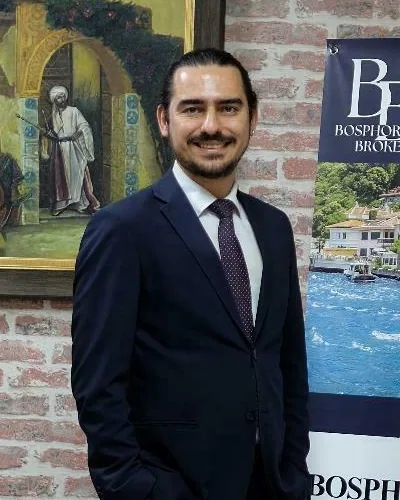
Written by
Burak Ünal
Turkish Real Estate Broker - License no. 3408704
Burak Ünal is a licensed real estate broker in Turkey (Ministry of Trade authorisation no. 3408704), licensed since 4 October 2022, the day he opened Bosphorus Brokers, his registered sole proprietorship. He handles purchases, sales and lettings of every kind for Turkish and international clients, across Istanbul and in other Turkish cities, and specialises in foreign buyers: the tax number and bank account, the currency exchange certificate (DAB), the land registry's identity declaration form, the official valuation report, the property conditions for a residence permit or citizenship, translators and powers of attorney, through to the title deed. He holds an MSc in Finance from the London School of Economics (2019) and a BSc in Business Management from Boğaziçi University (2016), and passed Turkey's official real estate broker licensing exam in 2021. A Chevening scholar and a Congress Member of Galatasaray Sports Club, he advises clients in English (IELTS 8.0), Turkish and French.