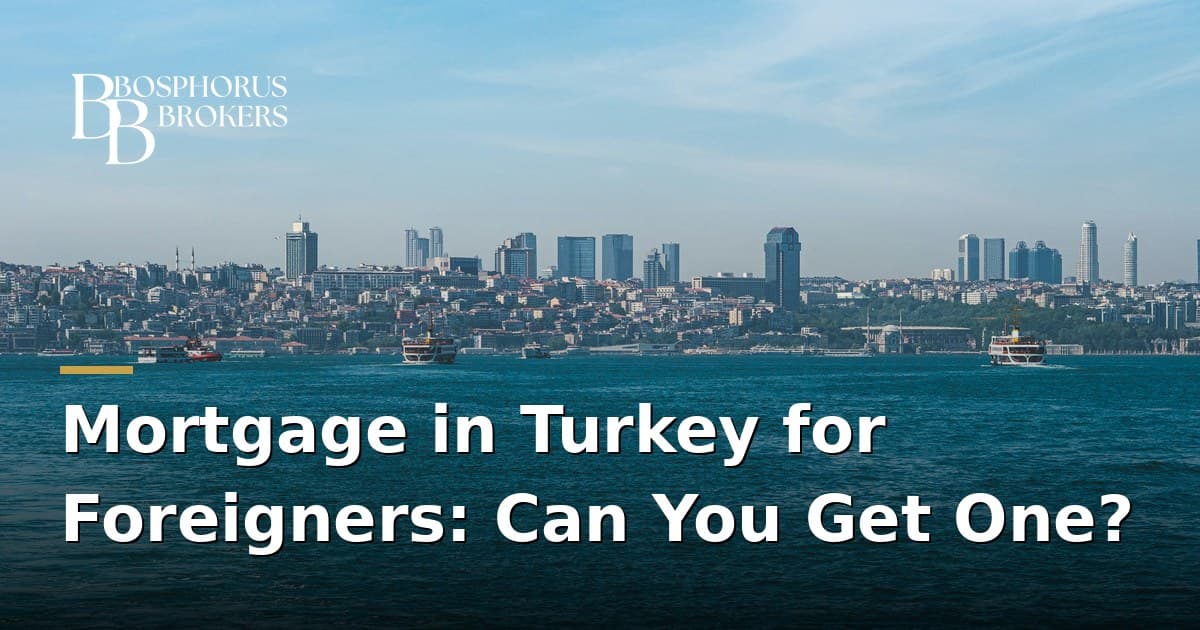
Yes, a mortgage in Turkey for foreigners is possible, and Turkish banks do lend to non-citizens who want to buy property here. The short answer is that you can usually borrow a portion of the price, often up to around half the property value, once the bank has valued the home and checked your income. This guide explains who can borrow, how much, what documents you need, what a home loan in Turkey for foreigners costs, and how the process works from application to title deed.
How a Mortgage in Turkey for Foreigners Works
Buyers often ask, can foreigners get a mortgage in Turkey, and the answer is a clear yes: it is a property-secured loan issued by a Turkish bank, with the home itself registered as collateral. When you take out the loan, the bank places a mortgage annotation (ipotek) on the title deed at the Land Registry, and that annotation is lifted once the loan is repaid in full. The property is both the reason for the loan and the security behind it, so the bank will not release funds until it is satisfied with the home and with you as a borrower.
Non-residents and residents can both apply, though the terms usually differ. Residents with a Turkish income record often secure slightly better conditions, while a first-time overseas buyer is assessed mainly on foreign income and the strength of the property. In our experience advising foreign buyers, the single factor that most often shapes the offer is the valuation report, because the bank lends against the appraised figure rather than the price you negotiated.
Mortgage in Turkey for Foreigners: How Much Can You Borrow?
Most foreign buyers can borrow up to around 50 percent of the property value, and sometimes a little more. Turkish citizens can often reach a loan-to-value of roughly 70 to 80 percent, but banks are more conservative with non-residents, so a 40 to 60 percent range is common as of the time this article is written. That means you should plan to fund at least half the purchase from your own money, plus the closing costs on top.
The loan term is normally shorter than buyers expect from home. Terms of around 5 to 10 years are typical for foreigners, and some banks stretch to 15 years for stronger files. The exact loan-to-value and term depend on the bank, your income, your age at the end of the term, and the type of property. Rates and lending limits move often, so treat these as a guide and confirm the current numbers before you commit.
Mortgage Requirements for Foreign Buyers in Turkey
The core mortgage requirements for foreign buyers in Turkey are a valued property, provable income, and a clean borrowing profile. Banks want to see that you can service the monthly payment comfortably, usually asking that the instalment stay within roughly a third to a half of your net monthly income. Beyond income, the property must be a type the bank is willing to finance.
Property conditions
Banks prefer completed residential property with a clear title and a finished habitation certificate (iskan). Off-plan units, land, and some commercial or rural properties are harder to finance, and a home in a military or security zone will not clear the standard checks that apply to foreign buyers. A licensed valuation, the SPK appraisal report, is ordered by the bank and sets the figure the loan is calculated against.
Borrower conditions
You will generally need to be under the bank's maximum age at loan maturity, often around 70 to 75, with income you can document. Self-employed and salaried applicants are both accepted, though the paperwork differs. The mortgage requirements for foreign buyers in Turkey also include a Turkish tax number and, in most cases, a Turkish bank account for the payments.
Documents You Need to Apply
A foreign mortgage application rests on a compact set of documents, most of which you can prepare before you travel.
- A valid passport, with a notarised Turkish translation where the bank asks for one.
- A Turkish tax number, which you obtain quickly from the local tax office of the Turkish Revenue Administration or online.
- Proof of income, such as recent payslips, an employer letter, or tax returns for the self-employed.
- Bank statements from the last few months, usually three to six.
- A credit report or reference from your home country, where available.
- The property details and the SPK valuation report, which the bank arranges.
- The tapu (title deed) information for the property you intend to buy.
Documents issued abroad often need translation and notarisation, and sometimes an apostille, so build a little time in for that. A power of attorney is commonly used when a buyer cannot stay in Turkey for every step, and it lets a trusted representative sign on your behalf.
Turkish Mortgage Interest Rates for Foreigners
Turkish mortgage interest rates for foreigners depend heavily on the currency of the loan. Loans in Turkish lira track domestic monetary policy and have carried high headline rates in recent years, which pushes monthly payments up sharply. Because of that, many overseas buyers look instead at foreign-currency options.
Some banks operating in Turkey, particularly international banks and their local branches, offer mortgages denominated in US dollars or euros to non-resident buyers. These foreign-currency loans usually carry lower nominal rates than lira loans, but they shift the exchange-rate risk onto you, since you repay in a currency that may move against your income. Turkish mortgage interest rates for foreigners change with market conditions, so the rate you are quoted this month may not hold next month. Ask each bank for the full annual cost including fees, not just the headline rate, and compare like for like.
The Mortgage Process Step by Step
The mortgage process runs alongside the purchase and usually takes a few weeks once your file is complete. The stages below show how a typical case moves from first enquiry to a registered title.
- Pre-check. You share your income and the target property with the bank, and it gives an indicative loan amount and rate.
- Tax number and account. You obtain a Turkish tax number and open a Turkish bank account, both of which are straightforward for foreigners.
- Valuation. The bank commissions the SPK appraisal report on the property, which sets the value the loan is based on.
- Application and underwriting. You submit your documents, and the bank reviews your income, the valuation, and the title.
- Offer. The bank issues a formal loan offer with the amount, term, rate, and any insurance conditions.
- Title transfer and mortgage registration. At the Land Registry the title passes to you and the mortgage annotation is registered at the same time, after which the bank releases the funds to the seller.
Because the valuation and title steps involve the Land Registry (Tapu Kadastro) and the bank in parallel, careful sequencing keeps the deposit protected and the timeline tight.
Costs Beyond the Loan
A mortgage adds several costs on top of the usual purchase expenses, and it helps to budget for them from the start. As of the time this article is written, the common extras include the following.
- Loan arrangement fee. Charged by the bank, usually a small percentage of the loan, and sometimes capped or waived.
- SPK valuation fee. Paid to the licensed appraiser through the bank, a fixed fee for the report.
- Mortgage registration. A Land Registry charge to annotate the ipotek on the title.
- Property (DASK) insurance. Mandatory earthquake cover, priced by the size and location of the home.
- Life insurance. Often required for the loan term, priced by your age and the sum insured.
These are separate from the standard buying costs, such as the title deed transfer fee and the property purchase tax. Confirm the exact fees with your bank, because the figures and which items are mandatory change over time.
Mortgages and Turkish Citizenship by Investment
A mortgage and the Turkish citizenship by investment route can coexist, but with an important limit. The citizenship programme generally requires a real estate investment of at least 400,000 US dollars as of the time this article is written, and the qualifying amount is expected to be your own funds rather than financed. You can still take a mortgage on a portion above that threshold, or on a separate property, while keeping the citizenship-qualifying amount as unencumbered equity.
The rules around financing and citizenship are applied strictly at the Land Registry and by the Citizenship and Population Directorate, so confirm them case by case. If citizenship is your goal, structure the purchase before you apply for any loan, so the qualifying property stays clean.
A mortgage in Turkey for foreigners is realistic. You can usually borrow around half the value over a shorter term, and you will need a Turkish tax number, documented income and a valued property. Weigh a lira loan against a foreign-currency loan carefully, budget for the extra costs, and sequence the steps around the Land Registry. Confirm every current figure before you sign, because a mortgage in Turkey for foreigners rewards preparation more than speed.
Looking to Buy, Rent, or Invest in Property in Turkey?
Bosphorus Brokers is an Istanbul-based licensed real estate brokerage that has helped foreigners buy, rent, manage and invest in property across Turkey. To discuss your own plans, reach us by phone or WhatsApp at +90 539 415 31 39, or visit us at Merkez Mahallesi Hasat Sokak No:12A, 34384 Şişli, İstanbul. Contact us for more information.
Frequently Asked Questions
Can foreigners get a mortgage in Turkey?
Yes, foreigners can get a mortgage in Turkey from Turkish banks, including some international banks with local branches. Non-residents typically borrow a smaller share of the property value than citizens and over a shorter term, but the option is genuinely available to overseas buyers.
How much can a foreigner borrow with a mortgage in Turkey?
A foreigner can usually borrow up to around 50 percent of the property value as of the time this article is written. Some banks lend a little more for strong applications, but you should plan to cover at least half the price plus closing costs from your own funds.
What are the main mortgage requirements for foreign buyers in Turkey?
The main mortgage requirements for foreign buyers in Turkey are documented income, a financeable property with a clear title, a Turkish tax number, and usually a Turkish bank account. The bank also orders an SPK valuation report and assesses whether the monthly payment fits your income.
Can I get a home loan in Turkey for foreigners in US dollars or euros?
Yes, a home loan in Turkey for foreigners is sometimes offered in US dollars or euros by certain banks. These foreign-currency loans often carry lower nominal rates than Turkish lira loans, but you take on the exchange-rate risk because you repay in that foreign currency.
What are Turkish mortgage interest rates for foreigners right now?
Turkish mortgage interest rates for foreigners vary by currency and change with market conditions. Lira loans have carried high headline rates in recent years, while dollar or euro loans usually price lower. Always ask for the full annual cost including fees and confirm the current rate with the bank.
How long does it take to arrange a mortgage in Turkey?
Arranging a mortgage in Turkey usually takes a few weeks once your documents and the valuation are ready. The timeline depends mainly on how quickly you provide income proof, obtain your tax number, and complete the SPK appraisal report.
Can I use a mortgage to qualify for Turkish citizenship by investment?
The citizenship-qualifying amount, at least 400,000 US dollars as of the time this article is written, is generally expected to be your own funds rather than financed. You can still take a mortgage on a portion above that threshold or on a separate property, but confirm the current rules before you apply.
About Bosphorus Brokers
Bosphorus Brokers is an Istanbul-based licensed real estate brokerage specialising in property sales, rentals, management and investment for foreigners in Turkey. Our multilingual team guides international clients through property search, negotiation, title deed transfer, notary procedures and after-sale management, working across Istanbul, Antalya, Bodrum, Fethiye, Izmir and Ankara. The firm is led by Burak Ünal, its founder and a licensed real estate broker in Turkey (Taşınmaz Ticareti Bilgi Sistemi, Real Estate License No. 3408704), who holds an MSc in Finance from the London School of Economics and a BBA from Boğaziçi University. We focus on clear, responsive and professional guidance at every step.
Disclaimer: This article is for general informational purposes only and you are strongly advised to consult a professional to evaluate your personal situation. No liability is accepted that may arise from the use of the information in this article.