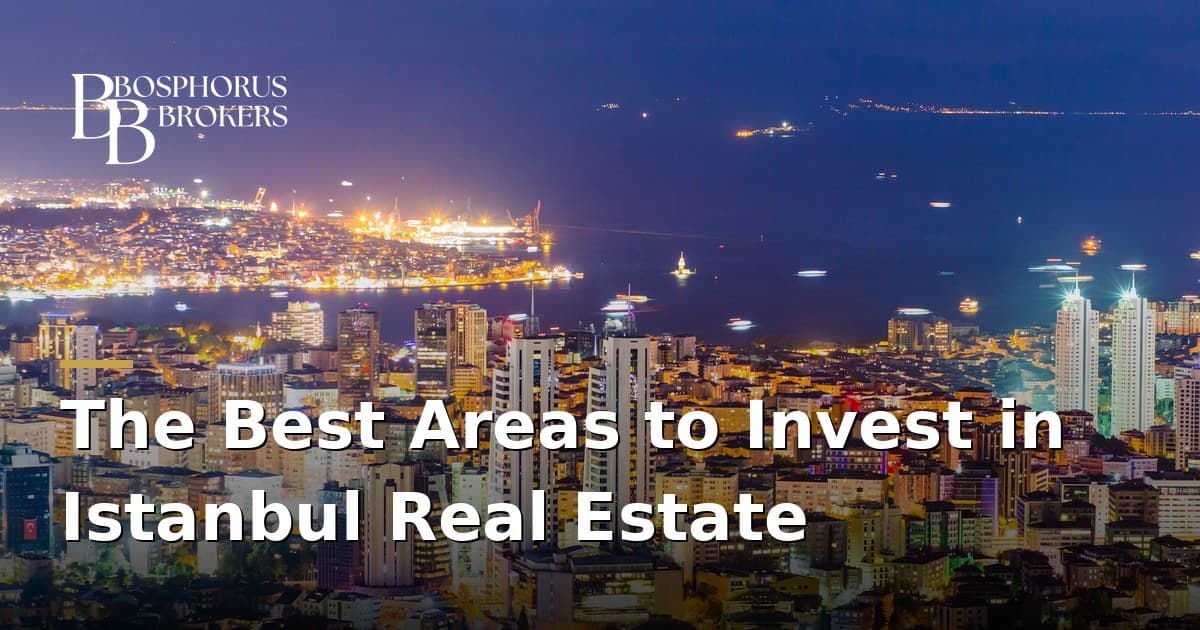
The best areas to invest in Istanbul are the districts that combine strong tenant demand, new transport links, and prices that still have room to rise. For rental income, that points to central European-side districts and the Kadikoy corridor on the Asian side. For capital growth, it points to newer development zones near Istanbul Airport and along the western commuter belt. This guide ranks the best areas to invest in Istanbul by goal, so you can match a district to what you actually want: monthly yield, long-term appreciation, or an easy resale.
We are Bosphorus Brokers, an Istanbul-based licensed real estate brokerage that helps foreigners buy, rent, manage and invest in property across Turkey. Below is a practical, district-by-district look at where to buy property in Istanbul, and how to read a neighborhood before you commit.
What Are the Best Areas to Invest in Istanbul?
The best areas to invest in Istanbul are the ones where tenant demand is dense, transport is improving, and the entry price leaves room for growth. Istanbul is not one market. It is dozens of local markets on two continents, and a flat that rents in days in one district can sit empty in another. Before naming districts, it helps to know what separates a strong Istanbul property investment area from a weak one.
- Transport access: proximity to a metro, Marmaray or metrobus line is the single biggest driver of tenant demand and resale speed.
- Tenant pool: areas near universities, hospitals and business districts rent quickly and rarely stay empty.
- Supply and price stage: newer districts still building out can offer lower entry prices and more upside than fully mature ones.
- Infrastructure in the pipeline: a new metro extension or hospital campus can lift an area's value before it is finished.
Read against those four points, the best neighborhoods to invest in Istanbul fall into clear groups: established central districts for reliable income, and newer western and northern districts for growth.
European Side vs Asian Side: Where to Buy Property in Istanbul
Whether to buy on the European or the Asian side is the first choice most foreign investors face, and both sides hold strong Istanbul property investment areas. The European side has the historic centre, the main business districts and the widest range of stock. The Asian side is generally calmer, greener and popular with families and long-term tenants. Here is how the two sides compare for an investor deciding where to buy property in Istanbul.
- Character: the European side is dense, business-driven and tourism-heavy, while the Asian side is more residential, greener and calmer.
- Rental demand: the European side draws very high demand from a broad mix of tenants, while the Asian side sees steadier demand from families and long-term renters.
- Entry price: the European side spans a wide range and costs more in the centre, while the Asian side often gives you better value for the space.
- Standout districts: on the European side, Sisli, Besiktas, Kagithane and Basaksehir; on the Asian side, Kadikoy, Atasehir, Uskudar and Maltepe.
- Best for: the European side suits central rental income and resale liquidity, while the Asian side suits stable long-term tenants and lifestyle buyers.
Neither side is universally better. The right answer depends on your budget and your goal, which is why we look at specific districts rather than continents.
Best Areas to Invest in Istanbul for Rental Income
The best areas to invest in Istanbul for rental income are central, well-connected districts with a deep and varied tenant pool. These are places where a job, a university or a metro station keeps a flat occupied year-round. If monthly yield is your priority, focus your search here. As a rough guide, gross rental yields in Istanbul often sit in the region of 4 to 6 percent a year, higher for well-located smaller flats and lower for large luxury units, as of the time this article is written.
- Sisli: a central European-side district close to business hubs, hospitals and metro lines, with steady demand from professionals and short-stay tenants.
- Besiktas: a lively, high-demand area near universities and offices, popular with younger tenants and rarely short of interest.
- Kadikoy: the Asian side's cultural heart, with strong demand from young professionals and easy Marmaray and ferry links to the European side.
- Atasehir: a planned Asian-side business district with modern residential stock and reliable corporate tenant demand.
- Beylikduzu: a western district offering newer flats at lower prices, popular with families and a good balance of yield and value.
In our experience advising foreign investors, the buyers who see the best rental performance choose a smaller, well-located flat near transport over a larger unit further out. A one or two-bedroom apartment within walking distance of a metro station in one of these districts is usually easier to let, and easier to sell later, than a bigger home that depends on a car.
Best Districts in Istanbul for Capital Growth
The best districts in Istanbul for property investment growth are the newer development zones where infrastructure is still arriving. These areas often start from a lower price and rise as metro lines, hospitals and business campuses open. Growth is slower to realise than rental income, so these districts suit buyers with a longer horizon.
- Basaksehir: a large, planned western district anchored by a major hospital campus and new metro links, built around modern family housing.
- Kagithane: a central district undergoing heavy redevelopment, close to the main business axis and benefiting from new transport.
- Bahcesehir: a self-contained western suburb with lakes, schools and newer stock, popular with families and steady on resale.
- Beykoz and the northern belt: greener, lower-density areas that tend to appreciate as the city expands outward.
Districts near Istanbul Airport on the northwest edge of the European side have also drawn investor attention, as improved road and metro access gradually connects them to the rest of the city. Istanbul keeps extending its metro network year by year, and a district that gains a new line often sees rents and prices move well before the first trains run. As with any growth play, confirm which infrastructure is actually funded and under way before you count on it.
Up-and-Coming Istanbul Property Investment Areas
Beyond the established names, several up-and-coming Istanbul property investment areas offer lower entry prices for buyers willing to wait. These districts carry more risk and depend on planned infrastructure, so they reward careful research over guesswork.
- Esenyurt: one of the most affordable large districts on the European side, with high rental turnover and a very wide range of stock quality, so selection matters.
- Kartal and Pendik: Asian-side coastal districts with metro and Marmaray links, redeveloping from older industrial zones into residential areas.
- Maltepe: a coastal Asian-side district with a growing seafront and improving transport, balancing price and lifestyle.
- Zeytinburnu: a central, historically industrial European-side district close to the old city, steadily gentrifying with new residential projects.
These are the best neighborhoods to invest in Istanbul for buyers chasing upside rather than immediate yield. The trade-off is patience: the value case rests on projects that take years to complete.
How to Choose the Best Areas to Invest in Istanbul
To choose the best areas to invest in Istanbul, match the district to your goal before you look at individual flats. The same budget buys very different outcomes depending on where and what you buy, so a clear method saves money and time. We guide clients through these steps:
- Define your goal. Decide whether you want rental income, capital growth, or a lifestyle property, since each points to different districts.
- Set an all-in budget. Include roughly 6 to 9 percent for taxes and fees on top of the price, as of the time this article is written.
- Shortlist districts, not just properties. Compare where to buy property in Istanbul by tenant demand, transport and price stage before viewing.
- Check the micro-location. Within a district, distance to a metro station, the age of the building and the floor level all move both rent and resale value.
- Verify the paperwork. Insist on the official SPK-authorised valuation report and confirm the title deed is clean before any money moves.
Working with a licensed brokerage in Istanbul gives you a local check at each step. That is the value we aim to add: honest district guidance, verified documents, and a purchase that still makes sense years later when you rent it out or sell.
Costs and Rules When You Invest in Istanbul Real Estate
When you invest in Istanbul real estate, budget for transaction costs of roughly 6 to 9 percent on top of the purchase price, though the exact total depends on the property and should be confirmed at the time of purchase. The main items are the title deed transfer tax (commonly 4 percent of the declared value), the mandatory SPK-authorised valuation report, notary and translation fees, the brokerage commission, a small annual property tax, and compulsory DASK earthquake insurance. For foreign buyers the SPK-authorised valuation report is mandatory rather than optional. It sets the official value your transfer tax is calculated on and gives you an independent check against overpaying.
Foreign buyers can own freehold property across almost all of Istanbul, holding the title deed (TAPU) in their own name at the Land Registry (Tapu Kadastro). A few limits apply, such as military or security zones and a cap on the total area one foreign national may own in a district, and a licensed broker checks these before you make an offer. A qualifying purchase of at least $400,000, held for three years, can also open a route to Turkish citizenship, as of the time this article is written. These figures and rules change often, so confirm current details with an advisor before you commit.
The best areas to invest in Istanbul are ultimately the ones that fit your goal, your budget and your time horizon. Central districts such as Sisli, Besiktas and Kadikoy lead for rental income, while Basaksehir, Kagithane and the western growth belt lead for appreciation. Decide what you want first, choose the district to match, and verify every document before the title transfers.
Looking to Buy, Rent, or Invest in Property in Turkey?
Bosphorus Brokers is an Istanbul-based licensed real estate brokerage that has helped foreigners buy, rent, manage and invest in property across Turkey. To discuss your own plans, reach us by phone or WhatsApp at +90 533 140 04 96, or visit us at Merkez Mahallesi Hasat Sokak No:12/2, 34384 Sisli, Istanbul. Contact us for more information.
Frequently Asked Questions
What are the best areas to invest in Istanbul?
The best areas to invest in Istanbul are central, well-connected districts such as Sisli, Besiktas, Kadikoy and Atasehir for rental income, and newer growth districts such as Basaksehir, Kagithane and Beylikduzu for capital appreciation. The right choice depends on whether you want yield, growth, or an easy resale.
Where should I buy property in Istanbul for rental income?
For rental income, buy in central districts with a deep tenant pool and good transport, such as Sisli, Besiktas, Kadikoy and Atasehir. A smaller flat near a metro station in these areas is usually easier to let and to resell than a larger home far from transport.
Is the European or Asian side better for investment?
Both sides hold strong Istanbul property investment areas, so neither is universally better. The European side leads for central business and tourism demand, while the Asian side offers calmer, greener districts popular with long-term family tenants and often better value for space.
Which Istanbul districts have the best capital growth?
The best districts in Istanbul for property investment growth are newer development zones where infrastructure is still arriving, such as Basaksehir, Kagithane, Bahcesehir and the western belt near Istanbul Airport. Growth takes longer to realise than rental income, so these suit patient buyers.
How much does it cost to invest in Istanbul real estate?
Beyond the purchase price, budget roughly 6 to 9 percent for transaction costs, as of the time this article is written. This covers the title deed transfer tax, the valuation report, notary and agency fees, a small annual property tax and DASK earthquake insurance.
Can foreigners buy property anywhere in Istanbul?
Foreigners can buy freehold property across almost all of Istanbul and hold the title deed in their own name. The main limits are military or security zones and a per-district area cap, which a licensed broker checks before you make an offer.
Can buying property in Istanbul lead to Turkish citizenship?
A qualifying property investment of at least $400,000, held for three years, can make you eligible to apply for Turkish citizenship, as of the time this article is written. Citizenship follows a separate application after the investment is confirmed; it is not granted automatically on purchase.
About Bosphorus Brokers
Bosphorus Brokers is an Istanbul-based licensed real estate brokerage specialising in property sales, rentals, management and investment for foreigners in Turkey. Our multilingual team guides international clients through property search, negotiation, title deed transfer, notary procedures and after-sale management, working across Istanbul, Antalya, Bodrum, Fethiye, Izmir and Ankara. The firm is led by Burak Unal, its founder and a licensed real estate broker in Turkey (Tasinmaz Ticareti Bilgi Sistemi, Real Estate License No. 3408704), who holds an MSc in Finance from the London School of Economics and a BBA from Bogazici University. We focus on clear, responsive and professional guidance at every step.
Disclaimer: This article is for general informational purposes only and you are strongly advised to consult a professional to evaluate your personal situation. No liability is accepted that may arise from the use of the information in this article.